Monteverdi; L’Orfeo

Brian Alvarado, Economics-Political Science, 2021

While the story of Orpheus is one of lost love, the tragic story begins with the love still intact. Starting on the 8:20 minute mark in Monteverdi’s L’Orfeo and following a long section of the piece of a single high-pitched voice representing Eurydice, the listener receives a brief section of minor-toned, legato strings that create a somber atmosphere mixed with the major-toned and smooth plucking sound of the harpsichord. There exists an element of confusion I believe is meant to represent the instant in which Eurydice fell to the ground and there was wonder regarding the moment during the wedding. Knowing the piece was meant to describe the story of Orpheus, I first thought a video of a far away tornado in an empty grass field was a good potential candidate for a matching video. The tornado represented the singular voice singing in varying volumes but in a strong tone in a background of organized strings and peaceful blades of grass. However, I came to see it more as the moment of confusion in the story– representing Orpheus’ thoughts when he saw Eurydice fall to the ground. The two meet, come together for an elegant and beautiful spectacle, followed by instant separation just as seen in the video of Grebe’s mating dance.

Renaissance/Early Baroque Word-Painting

Alex Anthony Cortes-Ose, Computer Science, 2022

As I listened to Claudio Monteverdi, Ah, dolente partita!, I was reminded of a dying flame. The text is about a lover’s betrayal and the pain felt by such a parting being like “the pain of death”. As a madrigal, the 5 a cappella voices with their spaced out entrances singing the very dissonant, descending melody perfectly embodies these themes. “A lively dying, which gives life to pain to let my heart immortally die” although this is a translation of the lines sung in the piece, these words made me picture the dying flame – what was once a fierce fire dies out slowly and completely, leaving only ashes.

Polyphony II: “Ave Maria” by Josquin Desprez

Avery Kim, Political Science, 2021

Watch: 0:53 to 2:07. Experience is best when the video montage is muted.

While it was “Ave Maria” by Josquin Desprez’s audible weaving of airy, legato notes that initially drove me to look for a video of flowers blooming, this unexpected video of sheep herding popped up and I found it to be even more fitting. Because of how polyphonous music often forges unity among differing melodies, the clips of the herd growing apart then coming together to continue running towards the same direction resemble this sonic quality. Furthermore, when closely watching a small section of the sheep, they do not all run at the same pace or in line with each other – allowing for some sheep to slightly overtake others, all while trotting in the same general direction, which mirrors how the vocalists’ melodies diverge then collide and complimentarily reunite.

Polyphony I: Rose, Liz, Printemps, Verdure

Kevin Li, Computer Science, 2020

I chose this video to represent the piece Rose, Liz, Printemps, Verdure by Machaut. The video shows several different people performing different tasks to create the Holiday Market at Union Square—building, painting, delivering, and selling goods. This parallels the polyphonous nature of the musical piece, in which the male and female parts sing different melodies, but they come together to create a cohesive whole. Just as the workers at Union Square build on each other’s work in creating the final product, as painters build on the structures others built, and shopkeepers sell in the booths that have been prepared, the male and female parts in Rose, Liz, Printemps, Verdure build on top of each other to create a cohesively whole musical piece.

02/05 – The Troubadours

Nicholas Lombardo
East Asian Studies
2020 (Senior)

  1. Studio Ghibli’s Whisper of the HeartShizuko discovering Nishi’s antique shop, the Barron, and the restored grandfather clock.
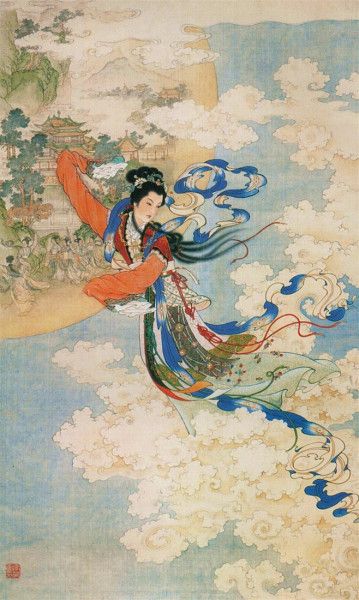
  2. Chang’e Flying to the Moon
A painting depicting 嫦娥 (Chang’e), the central figure of several Chinese folk tales surrounding 中秋节 (the Mid-Autumn Festival), flying to the moon

Listening to the troubadour lyric songs assigned for today, I kept having a distinct sense of longing and sadness. The lyrics, as well as the descriptions of some of the troubadours themselves, indicate a lot of emotion, especially romantic love, behind and composed into each song. Jaufre Rudel’s Lanquan li jorn in particular reminded me of the many stories of long-distance, eternal love shown in everything from folktales (Chang’e Flying To The Moon) to films (Whisper of the Heart). The painting above refers to a Chinese folk tale told during the Mid-Autumn Festival. In one iteration, the story surrounds a woman who protects her husband and prevents his elixir of immortality from falling into malicious hands taking the elixir herself and going to reside on the moon, where her husband can see her each night. The story, among other versions and tales, adds “romantic” sentiment to the Mid-Autumn Festival, during which people have traditionally revered the moon, and now will spend the evening together looking up at the moon, either in person or far apart. The film clip above shows Shizuko, protagonist of Japanese filmmaker Hayao Miyazaki’s Whisper of the Heart, meeting Nishi, an antique restorer and owner of an antique shop in Tokyo, and viewing a recently restored grandfather clock. The clock depicts a romance between a dwarf king who lives underground, and a fairy who is cursed to live as a sheep – the king may only see the fairy in her original form at the strike of 12 o’clock. These visuals and their tales seem to positively romanticize the longing and distance between those in love but apart, in contrast to Rudel’s piece whose sound and lyrics seem to suggest emphasis on the pain and sorrow.

Introduce Yourself (Example Post)

This is an example post, originally published as part of Blogging University. Enroll in one of our ten programs, and start your blog right.

You’re going to publish a post today. Don’t worry about how your blog looks. Don’t worry if you haven’t given it a name yet, or you’re feeling overwhelmed. Just click the “New Post” button, and tell us why you’re here.

Why do this?

  • Because it gives new readers context. What are you about? Why should they read your blog?
  • Because it will help you focus you own ideas about your blog and what you’d like to do with it.

The post can be short or long, a personal intro to your life or a bloggy mission statement, a manifesto for the future or a simple outline of your the types of things you hope to publish.

To help you get started, here are a few questions:

  • Why are you blogging publicly, rather than keeping a personal journal?
  • What topics do you think you’ll write about?
  • Who would you love to connect with via your blog?
  • If you blog successfully throughout the next year, what would you hope to have accomplished?

You’re not locked into any of this; one of the wonderful things about blogs is how they constantly evolve as we learn, grow, and interact with one another — but it’s good to know where and why you started, and articulating your goals may just give you a few other post ideas.

Can’t think how to get started? Just write the first thing that pops into your head. Anne Lamott, author of a book on writing we love, says that you need to give yourself permission to write a “crappy first draft”. Anne makes a great point — just start writing, and worry about editing it later.

When you’re ready to publish, give your post three to five tags that describe your blog’s focus — writing, photography, fiction, parenting, food, cars, movies, sports, whatever. These tags will help others who care about your topics find you in the Reader. Make sure one of the tags is “zerotohero,” so other new bloggers can find you, too.

Design a site like this with WordPress.com
Get started